1.
Hell Bent, by Leigh Bardugo. I remember I loved the first book in this series when I read it 5 years ago, but I genuinely struggle to remember the plot of it now. As I read this second instalment the broad strokes of the first book's plot came back to me. This book took me a while. I was at the initial descent before I got to a point where I didn't want to put it down and
still I struggled to pick it back up once I did. I adore Darlington and Pam, but I'm really not a fan of Alex and it always creates issues when the main character consistently makes me disinterested. The overarching plot is interesting and I do love the trope of magic being real, Alex just keeps pushing me away, which I guess is par for the course where she's concerned... She thinks she's broken, but honestly she's just traumatized and stuck in survival mode. Darlington, please, just tell her you love her. She needs it.
You need it.
2.
The Familiar, by Leigh Bardugo. I'm still reeling from that ending. So sad, so romantic, and so very perfect. I spent the first 90 pages or so being bored, but I usually try to give a book 100 pages before I give up, and this book had Bardugo's name on it, and despite my boredom it kept begging to be read, so I did. To nobody's surprise I absolutely adore Santángel. Luzia grew on me, but generally she was unremarkable. This is a historical fantasy set in 16th century Spain, and as much as I was intrigued by the magic, I wish there'd been more. More of it and more on it and more to it. Where does it come from? What makes it tick? How does it function? The main character's disinterest is the reader's frustration. I don't care that Luzia doesn't care,
I want to know. I love how the inquisition think magic is the devil, but tiny miracles (milagritos) are god, it's actually hilarious how they think there's a difference and that they can see the difference. As far as history goes it makes sense though. Like of course magic would be good if it suited them and equally it would be evil if it suited them. While the ending made me all sorts of sad, it was also absolutely perfect and oh so fitting. All the characters got exactly what they deserved and there was a real sense of satisfaction in reading the last few pages. As slow as this book was at the start it all came together beautifully. Also Monty Python have completely ruined the word "inquisition" for me...
3.
InterWorld, by Neil Gaiman & Michael Reaves. This book wants to be a lot all at once. The first half is a classic "ordinary kid discovers powers". Then we're off into a world that's a bit like an acid trip and a bit like a Disney movie (particularly that section in Dumbo, you know the one). This book uses that expression way too many times. "It was a bit like this and also a bit like this". I can't decide whether the action sequences feel like Spy Kids or Maze Runner. But the main character just conveniently knows things when it suits the plot. He's consistently called the strongest Walker in a decade, but we see no proof of this at all in the story. He stumbles more than his peers, he misses the mark more than they do. Hell, when he stumbles into the enemy headquarters it doesn't seem particularly urgent to use him for their own means, when that has been important earlier on in the book. He's banished and all his memories removed along with his ability to Walk, yet when the memories return so conveniently does his ability to Walk, and this is when we find out that all Walkers have a signature. Something not previously mentioned, and something that will make it possible for the enemies to find their way to Joey's home planet. This plot point is never touched on again, even though Joey spends literal pages agonising over the fact that he might lead enemies straight to his home if he Walks to save his friends. I know this book is for kids. I went in with that mindset, yet it's doing less than Percy Jackson or Skulduggery Pleasant while wanting to be more than both of those. It's definitely an interesting premise. It just feels so half-baked.
4.
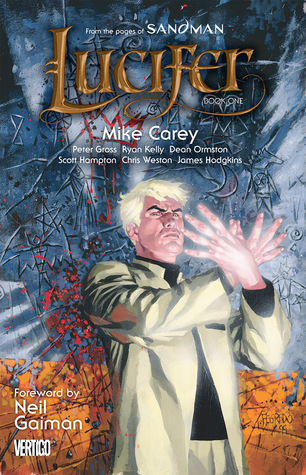
Lucifer, Book One, by Mike Carey. I knew this character was based on Lucifer from The Sandman before I picked it up. I knew the Lucifer TV show was (loosely) based on this comic, which is what made me decide to pick it up. I expected to enjoy it, but I enjoyed it a bit more than I had expected. I adore media that plays with the whole Christian mythology thing and this comic does it so well. I especially enjoyed the story arch with the girl who could see ghosts (I forget her name). I also really enjoyed Lucifer's meeting with part of the Japanese pantheon and how he handles himself there. Really nicely handled both by Lucifer and the writer. This version of Lucifer is far removed from the TV show. He's cold-hearted, snarky, and only looking out for himself. Sometimes he saves people when it benefits him or when it makes things difficult for Heaven, because he really doesn't like Heaven. Amenadiel is hugely different and disappointingly a pretty one-note character, but honestly Lucifer himself makes up for that. There are several references to The Endless and to Dream - a constant nod to The Sandman comics. The introductory chapters have a different illustrator than the rest of the book and while I don't really pay attention to art style, I do pay attention to words, and I was very grateful that they decided to drop the different-font-for-every-character thing they had going in the introductory chapters. It provides character, yes, but it also makes it a very distracting read. All of the angels have agendas and it's really interesting to see Lucifer navigate the whims of his brothers and the demands of a Heaven which he'd prefer to not have anything at all to do with. But behind all of these angels and demons shenanigans there are some really, really dark stuff happening. A gay man being sodomized with a broken beer bottle in a back alley by a guy he had a crush on and his Neo-nazi friends, a woman who's denied death by her gods and cursed to relive the same circumstances every day, so she suffers the same miscarriage every day for 4000 years, a girl who is pushed into traffic by her teacher because he believes she can identify him as a drug dealer, etc. It was a very memorable read to me and I'll be on the lookout for the second volume!
5.
Norse Mythology, by Neil Gaiman. I've had this book for ages but never read it until now. Having read it I can say that I already knew all the stories in it, but it was a nice little compilation of some of the most well-known myths of the Norse mythology. One interesting thing that I haven't noticed before is how Loki evolves from a mischievous trickster to a malicious villain as the myths progress towards Ragnarök. I love how Freya never backs down from fighting for her independence and rights. I enjoyed Frey's lovestory and as always I had a lot of fun with the story where Thor crossdresses. It was a very simplistic read and because he was telling somebody else's story while using somebody else's words it didn't feel like Gaiman. I had fun with it, I just came away from if with slight disappointment as if I had been expecting more than what this book gave me.



No comments:
Post a Comment
What's the first thought in your head after reading this? Let me know!